


Docker Swarm vs Kubernetes
Docker Swarm vs Kubernetes
In modern software development, applications are no longer deployed as single programs running on a single server. Instead, they are distributed systems composed of many services that must run reliably, scale efficiently, and recover automatically from failures. Containers have become the standard way to package applications, but managing containers across multiple machines introduces significant complexity.
Container orchestration platforms solve this problem by automating deployment, scaling, networking, and lifecycle management. Two of the most well-known orchestration tools are Docker Swarm and Kubernetes. Although both tools aim to solve the same fundamental challenges, they differ greatly in design, complexity, and ideal use cases.
1. Understanding Container Orchestration
Container orchestration refers to the automated management of containerized applications. This includes scheduling containers across multiple machines, ensuring high availability, managing networking between services, handling storage, and performing updates without downtime.
Without orchestration, teams must manually start containers, monitor failures, handle traffic routing, and scale services. As systems grow, this manual approach becomes unreliable and error-prone.
Docker Swarm and Kubernetes both provide solutions to these challenges, but they approach the problem from different perspectives.
2. Docker Swarm: In-Depth Explanation
2.1 Overview of Docker Swarm
Docker Swarm is Docker’s native orchestration solution. It is built directly into the Docker Engine, which means no additional software is required to start using it. A collection of Docker hosts can be combined into a single cluster called a swarm.
Docker Swarm was designed with simplicity in mind. If a user already understands Docker commands and concepts, learning Docker Swarm feels natural and intuitive.
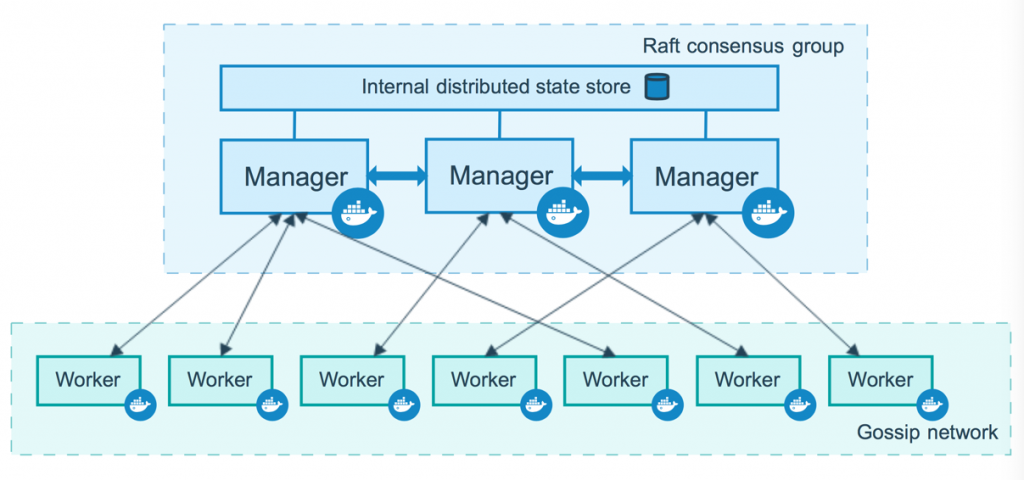
2.2 Docker Swarm Architecture
A Docker Swarm cluster consists of two types of nodes:
- Manager Nodes - Responsible for maintaining the cluster state, scheduling services, and handling orchestration decisions.
- Worker Nodes - Responsible for running the containers assigned to them by the manager.
Manager nodes use a consensus mechanism to ensure consistency and reliability. Worker nodes focus only on executing workloads.
2.3 Services and Tasks
In Docker Swarm, applications are deployed as services. A service defines how many container replicas should run and which image should be used. Each running container is referred to as a task.
Docker Swarm continuously monitors tasks and ensures that the desired number of replicas is always running.
2.4 Key Features of Docker Swarm
Simple Setup: Initializing a swarm requires only a single command. New nodes can join securely using a generated token.
Built-in Load Balancing: Docker Swarm automatically distributes traffic among service replicas using an internal routing mesh.
High Availability: If a node or container fails, Docker Swarm reschedules tasks on healthy nodes.
Rolling Updates: Services can be updated gradually without stopping the application.
2.5 Advantages of Docker Swarm
- Very easy to learn and use
- Native integration with Docker
- Low operational complexity
- Fast deployment and scaling
2.6 Limitations of Docker Swarm
- Limited ecosystem
- Fewer advanced features
- Not ideal for very large or complex systems
3. Kubernetes: In-Depth Explanation
3.1 Overview of Kubernetes
Kubernetes is an open-source container orchestration platform originally developed by Google and now maintained by the Cloud Native Computing Foundation (CNCF).
Kubernetes was designed to run applications at massive scale and is widely considered the industry standard for container orchestration.
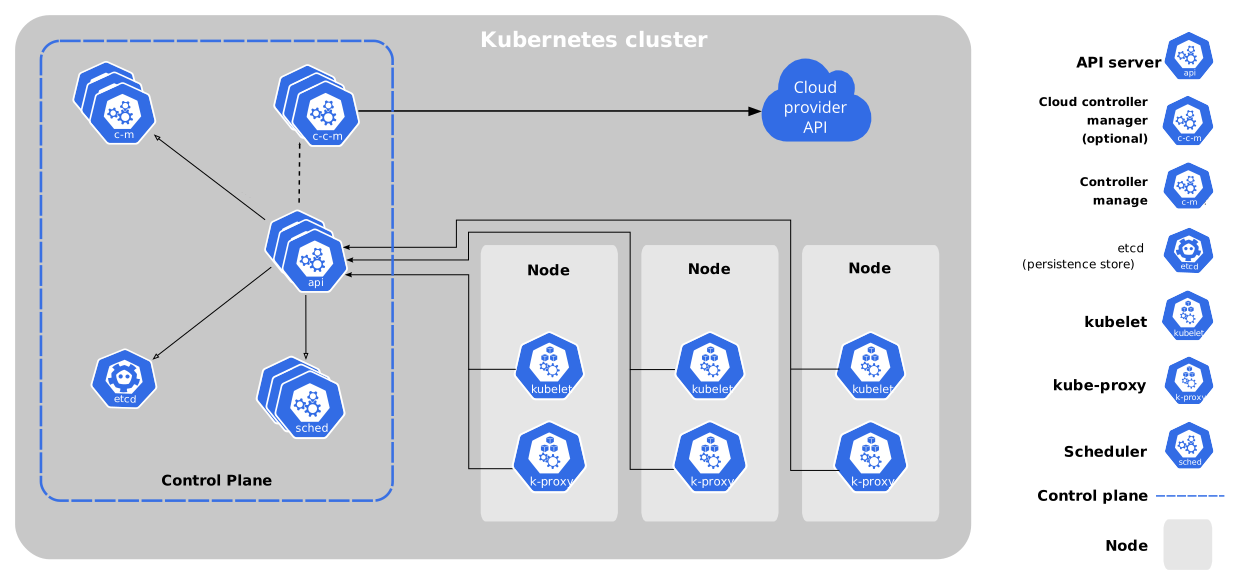
3.2 Kubernetes Architecture
Kubernetes follows a control-plane and worker-node architecture.
Control Plane Components:
- API Server - Entry point for all cluster operations
- Scheduler - Assigns workloads to nodes
- Controller Manager - Maintains desired state
- etcd - Stores cluster configuration and state
Worker Node Components:
- Kubelet - Communicates with the control plane
- Container Runtime - Runs containers
- Kube-proxy - Manages networking rules
3.3 Pods and Deployments
The smallest deployable unit in Kubernetes is a pod. A pod may contain one or more containers that share storage and networking.
Deployments define how pods should be created, scaled, and updated. Kubernetes ensures that the actual system state always matches the desired configuration.
3.4 Key Features of Kubernetes
Self-Healing: Automatically restarts failed containers and replaces unhealthy nodes.
Automatic Scaling: Supports scaling based on resource usage or custom metrics.
Advanced Networking: Provides a flat network model where all pods can communicate.
Storage Orchestration: Supports multiple persistent storage backends.
3.5 Advantages of Kubernetes
- Extremely scalable
- Highly fault-tolerant
- Large ecosystem and community
- Cloud and vendor neutral
3.6 Challenges of Kubernetes
- Steep learning curve
- Complex setup and maintenance
- Higher operational overhead
4. Docker Swarm vs Kubernetes
| Aspect | Docker Swarm | Kubernetes |
|---|---|---|
| Ease of Use | Very Easy | Complex |
| Scalability | Moderate | Very High |
| Ecosystem | Limited | Extensive |
| Best For | Small to Medium Systems | Large Distributed Systems |
5. Use Case Recommendations
Docker Swarm is ideal for teams that need simplicity, fast deployment, and minimal configuration.
Kubernetes is better suited for organizations that require high scalability, resilience, and advanced orchestration features.
6. Conclusion
Docker Swarm and Kubernetes both play important roles in container orchestration. Docker Swarm emphasizes simplicity and speed, while Kubernetes focuses on power, flexibility, and scalability.
Choosing the right tool depends on project size, team expertise, and long-term goals. Understanding both platforms allows teams to build reliable and efficient containerized systems.
© SNA Mart. All Rights Reserved. Designed by HTML Codex